
Source-available · On the plan's own servers · Works behind Perfuse
Prior authorization that has to show its work.
Vaglio decides a health plan's prior authorization requests, and every answer it gives is a proof: the plan's own policy quoted word for word, the place in the patient's record each finding came from, and every step between them. When the record leaves a gap, Vaglio does not deny. It asks for the missing evidence by name.
Demo sign-in demo / try-vaglio-demo. Invented requests only; look at everything, change nothing.
Not denied. Two pieces of evidence would settle it.
- Six weeks of conservative therapy, without reliefFound: the provider's questionnaire answer, item
conservative-therapy - No red-flag finding is claimedFound: no qualifying diagnosis in the request's conditions
- ?A lumbar MRI in the last six monthsThe record does not say either way. Asked for by name.
- ?New or worsening symptoms since thenNeeded only if there was a recent MRI. Asked for by name.
“A repeat MRI within six months of a prior study is not indicated unless the condition has changed.”The plan's policy, quoted exactly
VG-7K2D-Q9XM-4HTB-R3WCCheckable against the logWhat it does
Twelve ideas, each explained from the beginning
Every square opens a long article in plain words. Start anywhere; each one stands on its own.
Start here
What prior authorization is, why it is in the news, and what Vaglio has not done yet.
Deciding
How a request becomes an answer, and why that answer can always be shown.
Oversight
People stay in charge, and anyone can check what was decided.
Running it
How it fits a plan's systems, its servers and its policies.
How a request is decided
From a doctor's request to an answer anyone can check
- 1
It arrives
Through the plan's prior authorization server, such as Perfuse, in the Da Vinci PAS standard, or keyed in from a fax, a call or the provider portal. Every route reaches the same engine.
- 2
The evidence is found
Vaglio reads the patient's record in the request and finds each piece of evidence the policy names, noting exactly where it came from.
- 3
It decides, with proof
The plan's signed policy is applied. The answer is approve, deny with its proof, or pend with the missing evidence named. Anything uncertain goes to a person.
- 4
It is recorded
The decision goes into a tamper-evident log before the answer is sent, with a receipt anyone holding it can check later.
What it looks like
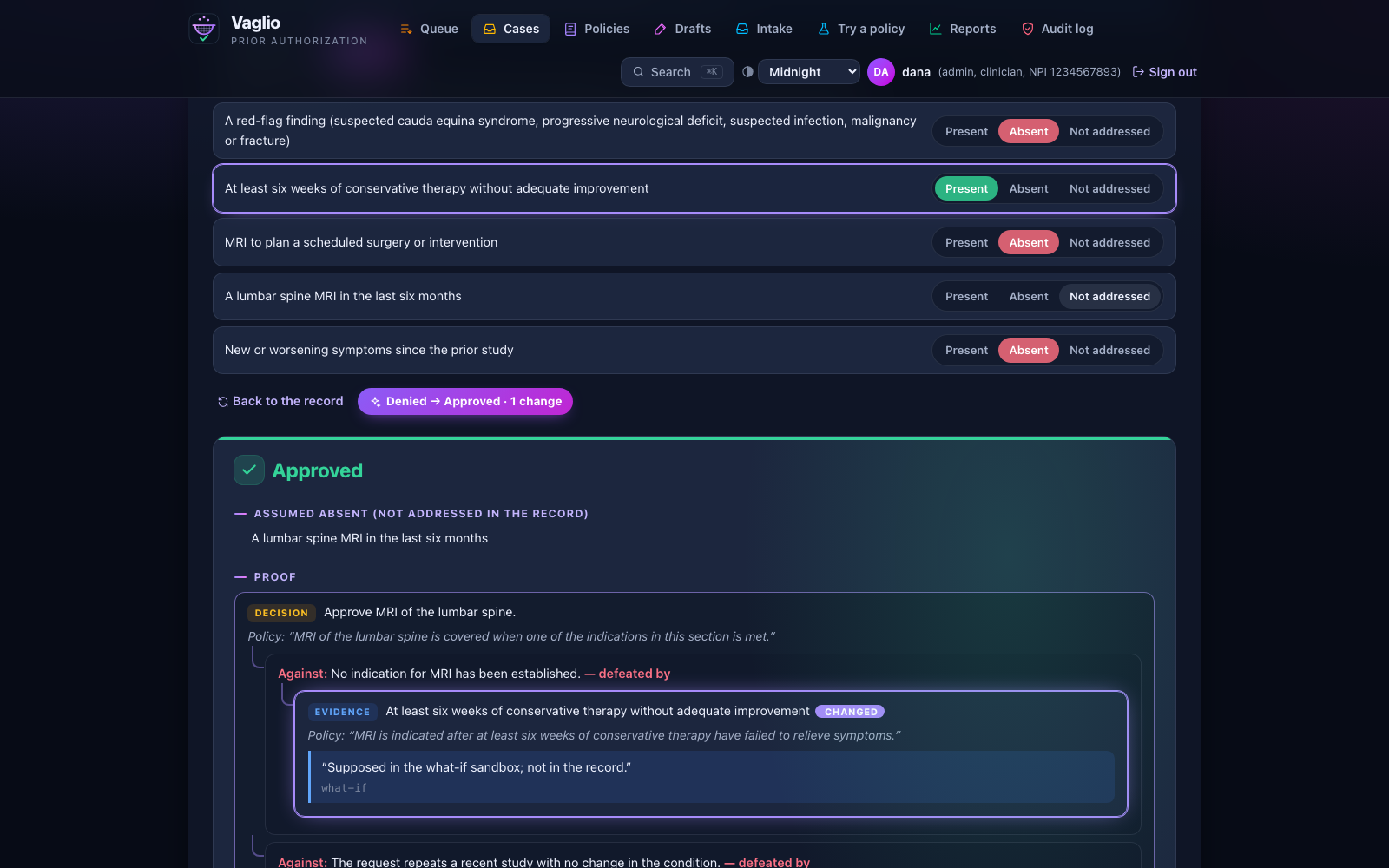
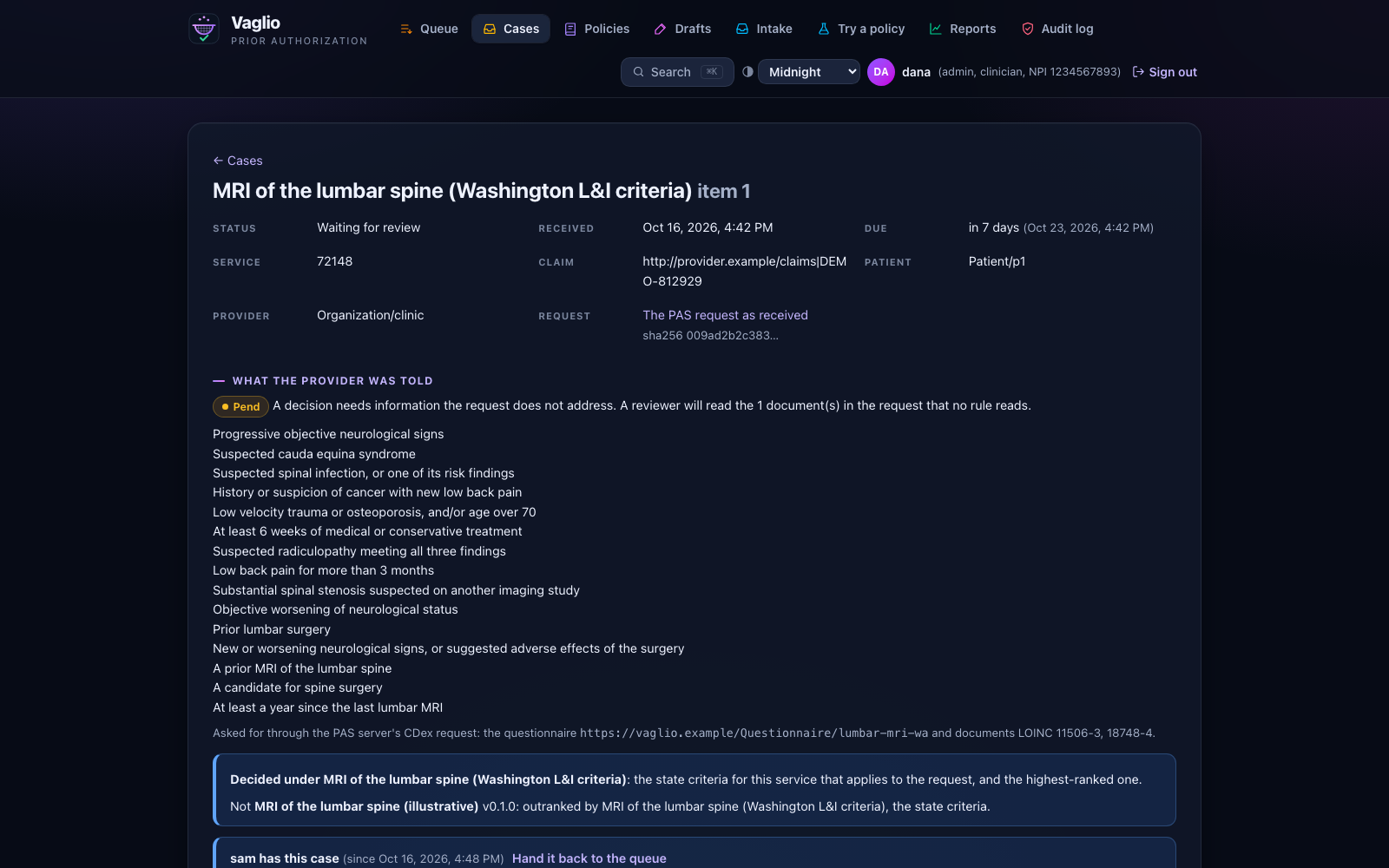
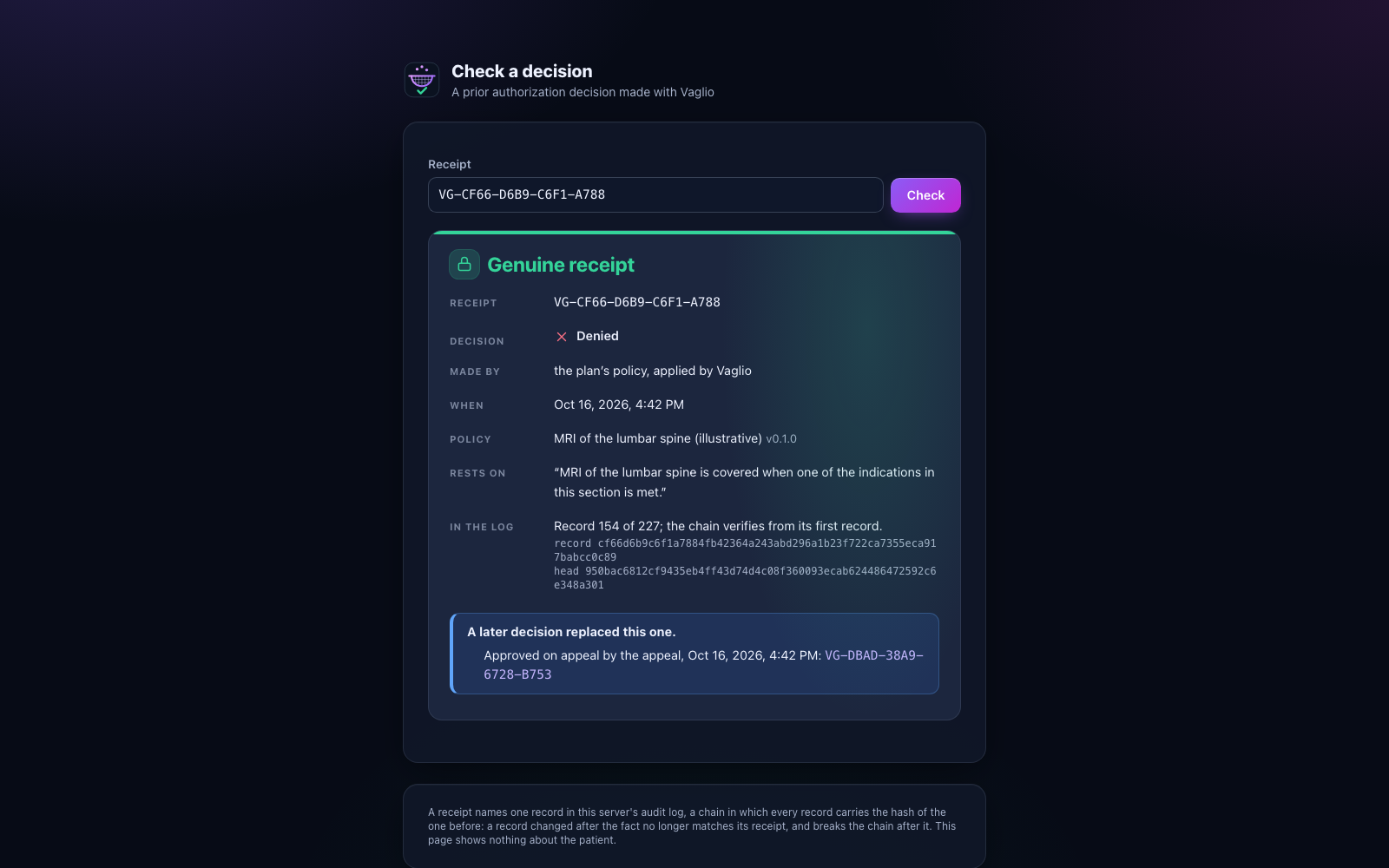
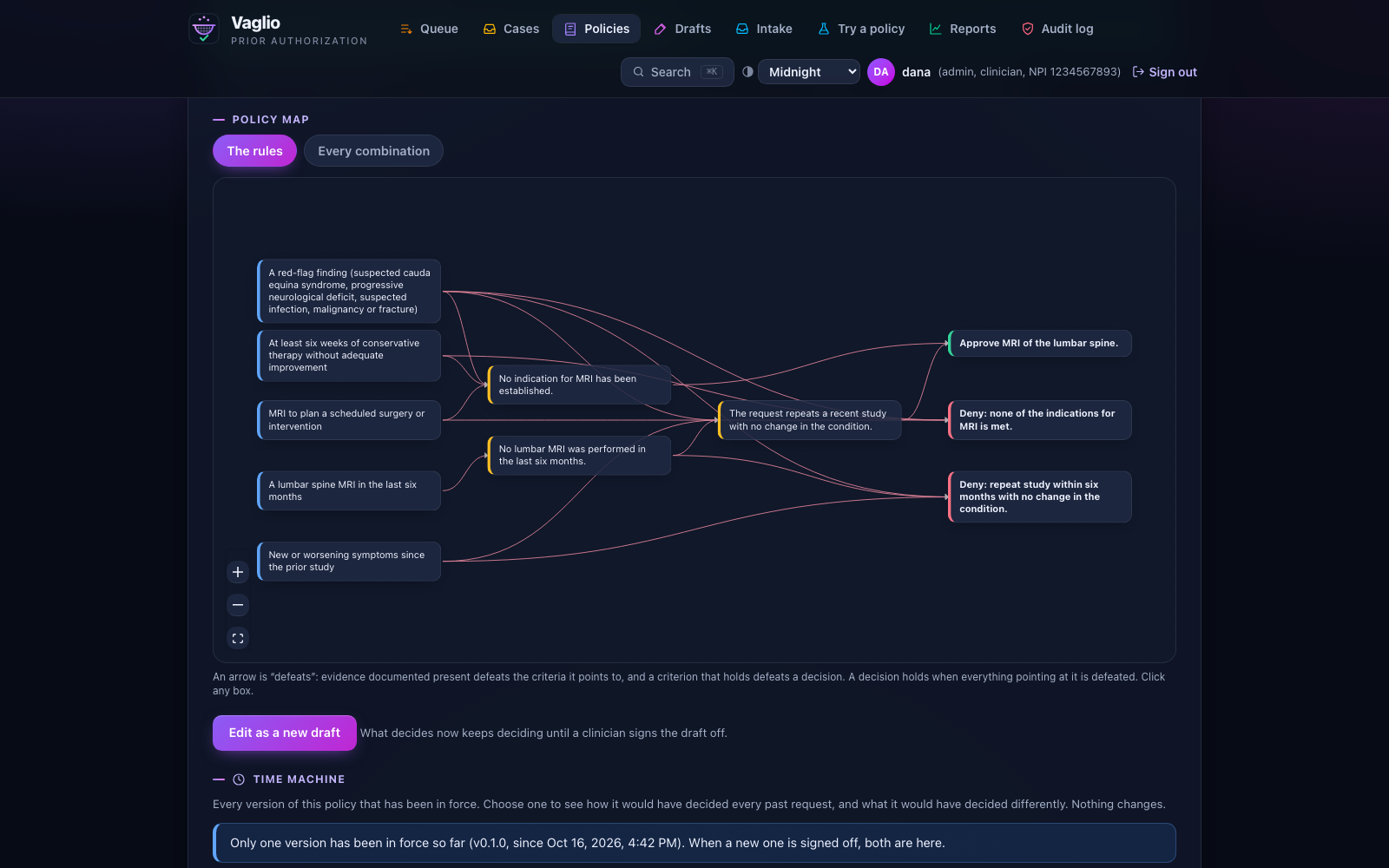
The reviewer sees why, not just what
The console is built into the program. These are screens from the public demonstration.
- No health plan runs it in production. Everything has been built and tested, on invented requests and against standard test kits, but no real patient's request has been decided by it.
- It ships no licensed clinical criteria. InterQual and MCG are licensed products. Vaglio's library is drafted from public Medicare documents; a plan brings its own policies or its own licence.
- Nobody outside BioDream has reviewed it. Its threat model, safety hazard log and HIPAA mapping are written down and published, but no independent auditor or clinician has signed them.
- It is not certified. No SOC 2, no HITRUST, no penetration test by an outside firm, and no service levels: it is software a plan runs, not a service someone runs for it.
See it decide a request
The demonstration decides an invented lumbar MRI request every 20 minutes, and starts again every night. Open a case, flip its evidence, read its letter in English or Spanish, and check its receipt.